



Energy security depends on domestic control of the materials powering lithium-ion batteries, not just local battery assembly. Yet cathode active materials (CAM), which determine stored energy and dominate battery performance and cost, remain heavily concentrated in China and South Korea. As demand for high-energy, high-power lithium-ion batteries grows across drones, robotics and data centers, this dependence leaves a critical gap in the U.S. battery supply chain.
eJoule is developing a new path to close this supply chain gap. It produces CAM through a precursor-free production process, bypassing the conventional precursor supply chain and enabling a localized route to lithium-ion battery materials. Combined with its single-crystal nickel-cobalt-manganese (NCM) synthesis, the approach cuts waste from precursor production and improves cathode durability.
“Our goal is to advance cathode manufacturing through true innovation while avoiding the solid waste, wastewater and environmental compliance challenges associated with conventional processes,” says Dr. Liang Chen, CEO.
Its patented precursor-free cathode manufacturing process, known as the Dynamic Crystallization Platform (DCP®), uses single droplet synthesis and a dynamic crystallizer to control particle formation and crystallization.
Replacing the Precursor-Based Route
eJoule begins with a controlled chemical solution of the complete composition rather than a precursor-CAM NCM oxide. Lithium, nickel, cobalt, manganese and dopants are dissolved together at defined concentrations before a micromachined Power Jet process converts the solution into precisely controlled droplets. These are synthesized into powder before entering the dynamic crystallizer, where particle crystallinity is improved under controlled conditions.
Conventional solid-powder precursor-CAM mixing with lithium salts and static crucible calcination can take 30 to 40 hours, while eJoule’s dynamic crystallization takes about 10 hours. By bypassing conventional precursor production and washing, the process avoids the solid-waste and wastewater streams associated with those steps.
The distinction begins with chemical uniformity. Conventional processing mixes solid materials and relies on subsequent diffusion to distribute lithium and dopants during calcination. eJoule establishes the intended elemental concentrations in solution before particle formation, giving the process greater control over composition and providing uniform distribution in the particle.
Engineering Single-Crystal Performance
The incumbent polycrystalline NCM can develop microcracks during repeated charging and discharging, undermining durability. This NCM supports higher energy density but can face durability challenges. eJoule aims to preserve NCM’s energy-density potential while improving durability through single-crystal morphology designed to resist microcracking. Its customer testing has demonstrated a cycle life of approximately 3,000 to 4,000 cycles.
 Achieving these characteristics requires precise control over cathode composition, structure and density. eJoule uses special dopants and controls the lithium content, particle morphology and size. Its single-crystal materials can accommodate 20 to 30 percent more cathode material within the same electrode thickness, supporting higher electrode density and potentially improving energy density.
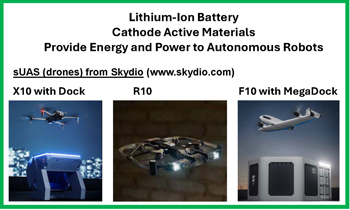 The process also allows cathode chemistry to be adjusted for different requirements. Mid-nickel formulations and higher-nickel chemistries meet varying needs, with higher-nickel options suited to energy-intensive applications like drones. This enables manufacturers to select an NCM chemistry that balances the application’s performance and cost requirements.
eJoule has progressed beyond laboratory development, with revenue-generating operations, customer-validated materials and smaller-scale cathode production in the United States and Taiwan. This existing activity provides a foundation for expanding localized manufacturing and reducing reliance on conventional precursor supply chains.
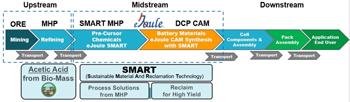
Beyond battery performance, eJoule’s precursor-CAM-free approach creates a pathway from mined materials to cathode production, supporting a more localized mine-to-cathode model. Subject to securing funding, eJoule plans to establish cathode-material production facilities in the U.S. and Canada, extending its localized manufacturing model across North America.
By combining precursor-CAM-free manufacturing with single-crystal cathode synthesis, eJoule is pursuing two connected goals: strengthening domestic access to critical battery materials and improving the durability and density of high-performance cathodes. This combination of manufacturing innovation and material engineering underpins its recognition as the Top Lithium-Ion CAM Single-Crystal Synthesis Platform 2026.
eJoule is developing a new path to close this supply chain gap. It produces CAM through a precursor-free production process, bypassing the conventional precursor supply chain and enabling a localized route to lithium-ion battery materials. Combined with its single-crystal nickel-cobalt-manganese (NCM) synthesis, the approach cuts waste from precursor production and improves cathode durability.
“Our goal is to advance cathode manufacturing through true innovation while avoiding the solid waste, wastewater and environmental compliance challenges associated with conventional processes,” says Dr. Liang Chen, CEO.
Its patented precursor-free cathode manufacturing process, known as the Dynamic Crystallization Platform (DCP®), uses single droplet synthesis and a dynamic crystallizer to control particle formation and crystallization.
Replacing the Precursor-Based Route
eJoule begins with a controlled chemical solution of the complete composition rather than a precursor-CAM NCM oxide. Lithium, nickel, cobalt, manganese and dopants are dissolved together at defined concentrations before a micromachined Power Jet process converts the solution into precisely controlled droplets. These are synthesized into powder before entering the dynamic crystallizer, where particle crystallinity is improved under controlled conditions.
Conventional solid-powder precursor-CAM mixing with lithium salts and static crucible calcination can take 30 to 40 hours, while eJoule’s dynamic crystallization takes about 10 hours. By bypassing conventional precursor production and washing, the process avoids the solid-waste and wastewater streams associated with those steps.
-
Our goal is to advance cathode manufacturing through true innovation while avoiding the solid waste, wastewater and environmental compliance challenges associated with conventional processes.
The distinction begins with chemical uniformity. Conventional processing mixes solid materials and relies on subsequent diffusion to distribute lithium and dopants during calcination. eJoule establishes the intended elemental concentrations in solution before particle formation, giving the process greater control over composition and providing uniform distribution in the particle.
Engineering Single-Crystal Performance
The incumbent polycrystalline NCM can develop microcracks during repeated charging and discharging, undermining durability. This NCM supports higher energy density but can face durability challenges. eJoule aims to preserve NCM’s energy-density potential while improving durability through single-crystal morphology designed to resist microcracking. Its customer testing has demonstrated a cycle life of approximately 3,000 to 4,000 cycles.
Achieving these characteristics requires precise control over cathode composition, structure and density. eJoule uses special dopants and controls the lithium content, particle morphology and size. Its single-crystal materials can accommodate 20 to 30 percent more cathode material within the same electrode thickness, supporting higher electrode density and potentially improving energy density.The process also allows cathode chemistry to be adjusted for different requirements. Mid-nickel formulations and higher-nickel chemistries meet varying needs, with higher-nickel options suited to energy-intensive applications like drones. This enables manufacturers to select an NCM chemistry that balances the application’s performance and cost requirements.eJoule has progressed beyond laboratory development, with revenue-generating operations, customer-validated materials and smaller-scale cathode production in the United States and Taiwan. This existing activity provides a foundation for expanding localized manufacturing and reducing reliance on conventional precursor supply chains.
Beyond battery performance, eJoule’s precursor-CAM-free approach creates a pathway from mined materials to cathode production, supporting a more localized mine-to-cathode model. Subject to securing funding, eJoule plans to establish cathode-material production facilities in the U.S. and Canada, extending its localized manufacturing model across North America.
By combining precursor-CAM-free manufacturing with single-crystal cathode synthesis, eJoule is pursuing two connected goals: strengthening domestic access to critical battery materials and improving the durability and density of high-performance cathodes. This combination of manufacturing innovation and material engineering underpins its recognition as the Top Lithium-Ion CAM Single-Crystal Synthesis Platform 2026.
