


The success of every capital investment a utility makes rests on a foundation of data that provides visibility into asset locations, condition and degradation rates as well as insights where failure risk is highest. That data is critical. And yet that foundation is not nearly as strong as it needs to be for most utilities today.
For transmission and distribution networks that can span thousands of miles, traditional models for assessing asset condition for large-scale infrastructure are no longer sufficient to meet the demands placed on them. Simply put: utilities do not have clear vision into the most important information they need to steer their grid investments.
This is a major vulnerability for utilities at a time when grid infrastructure is aging, regulatory scrutiny is increasing, and capital budgets remain constrained. It is also problematic as electrification, distributed energy resources (DERs) and extreme weather events place greater demands on grid infrastructure. To complicate things further, the aging workforce of the utility industry means that workers with the bulk of institutional knowledge are entering retirement age.
The result is a persistent gap between what utilities know about their assets and what they need to know to make defensible investment decisions.
Maintenance crews are dispatched by schedule rather than by risk. High-severity defects go undetected between inspections. Capital projects are justified with incomplete evidence of condition. When regulators ask utilities to demonstrate that their O&M and capital spending reflect real-world risk, the answers are often difficult to defend.
Utilities can close that gap with a stronger foundation of data that drives smart, defensible investments and delivers results. But closing that gap requires a fundamentally different approach than what most utilities use today.
Utilities need to transform raw source data into continuous, enterprise-wide asset intelligence. By combining multimodal image acquisition with AI, computer vision and deep integration with GIS and enterprise asset management systems, utilities can shift from ad-hoc, snapshot-based inspections to a dynamic, condition-driven model. They then gain the power to accurately inform risk scoring, work prioritization and capital queuing using timely, accurate and complete data.
The Hidden Cost of Incomplete Asset Intelligence
The scale of the asset data problem continues to grow. Seventy percent of U.S. transmission lines are nearing the end of their typical 50- to 80-year lifecycle. At the same time, growing capacity constraints, rising demand from electrification and data centers and aging infrastructure all contribute to system complexity. A Tier 1 utility may manage tens of thousands of miles of transmission and distribution lines and millions of individual structures. The idea that periodic, manual inspections can provide adequate situational awareness across that asset base has become untenable.
Most utilities inspect roughly one-third of their assets each year, leaving the rest of the network either unknown or based on outdated data. Maintenance is schedule-driven, not risk-driven, so crews may repair lower-severity defects while high-severity issues go undetected on the same circuit. The result is a capital planning process built on an incomplete picture and maintenance spending poorly aligned with actual risk.
Fragmentation makes it worse. Functional teams procure imagery independently and store it in separate silos, so data collected for one use case never reaches teams that could benefit from it. The enterprise pays multiple times to cover the same corridors and still lacks a unified view of system risk.
Data quality suffers as a result. Asset records are incomplete, and historical imagery resides in disconnected repositories with sparse metadata. Without a reliable time dimension, planners can’t determine whether a defect is new or long-standing, whether deterioration is accelerating, or how condition data correlates with OT parameters, forcing capital decisions based on assumptions rather than evidence.
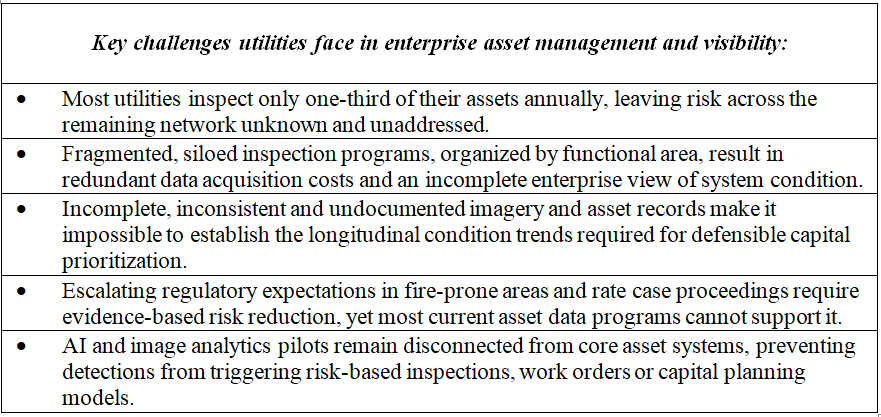
Regulatory pressure has turned these gaps into compliance exposure. Regulators in fire-prone regions expect demonstrated, evidence-based awareness of conditions. Rate cases demand defensible investment rationales. Incomplete condition data makes both harder to deliver.
Internal capacity constraints compound the problem. Staff cannot manually review imagery for millions of structures. AI and analytics pilots have been attempted, but findings remain trapped in vendor portals and spreadsheets, disconnected from the asset registers and planning models that need them. What’s been missing is an enterprise framework that integrates acquisition, governance, analytics and integration into a coherent capability.
From Raw Pixels to Enterprise Asset Intelligence: A Platform Approach
Closing the asset visibility gap demands a purpose-built enterprise platform that is cloud-native, AI-ready, integrated with GIS and EAM systems, and that governs the entire journey from field image capture to capital investment decisions. We can address this through three pillars: a coordinated acquisition strategy, centralized data management and AI governance and targeted analytics that deliver immediate and sustained value.
The acquisition strategy starts with understanding what already exists. The first step is to inventory existing imagery and remote sensing assets across the organization, surfacing what has been purchased, where it is stored and which use cases it supports. This typically reveals hidden value that can be activated immediately, as well as gaps where condition data is missing or inadequate. From that evaluation, we can build a multimodal acquisition plan: passive capture on vehicles already in the field where corridors overlap with maintenance routes, drone missions scoped to analytics specifications and aerial or satellite sources for large-scale coverage. The discipline is ensuring acquisition specs match downstream model requirements — the right resolutions, angles and sensor payloads for each use case.
The second pillar focuses on a centralized data management and integration hub. The most common failure mode in utility imagery programs is not a lack of data; it is data that is undiscoverable and ungoverned. From experience, the best approach is to consolidate imagery from departmental silos into a cloud-native repository, where data standards, security controls and retention policies are applied consistently. Automated ingestion pipelines normalize imagery into common formats, ensuring every image is indexed and discoverable by asset ID, circuit, geography or time window. AI models detect and obscure personally identifiable information before imagery is stored or shared. Well-documented APIs and machine-readable metadata make the platform AI-ready, enabling new computer vision capabilities to be deployed without rearchitecting the underlying infrastructure.
The third pillar is analytics that transform that data into actionable insights. Configurable machine learning pipelines run automated first-pass analysis across poles, conductors, insulators, vegetation and substations, detecting crossarm damage, cracked insulators, frayed conductors, thermal anomalies and encroachments at a scale manual review cannot match. The key discipline is mapping the right models to the right use cases, since circuit patrol, substation inspection and vegetation management each require different sensor inputs and architectures.
The platform becomes transformative through integration. Condition detections don’t end in a portal — a detected pole defect becomes an updated asset condition record, a prioritized work order and an input to capital planning models. Standards-based APIs connect imagery-derived insights to GIS, EAM, WAM, ADMS and OMS, ensuring they inform regulatory filings and investment plans. This is the feedback loop that closes the gap between field reality and capital decision-making.
Getting started does not require a full enterprise deployment. I recommend starting with a few high-value use cases, such as overhead circuit patrol, wildfire risk mitigation, or substation assessment, that deliver quick returns while laying the groundwork for broader adoption.
For transmission and distribution networks that can span thousands of miles, traditional models for assessing asset condition for large-scale infrastructure are no longer sufficient to meet the demands placed on them. Simply put: utilities do not have clear vision into the most important information they need to steer their grid investments.
This is a major vulnerability for utilities at a time when grid infrastructure is aging, regulatory scrutiny is increasing, and capital budgets remain constrained. It is also problematic as electrification, distributed energy resources (DERs) and extreme weather events place greater demands on grid infrastructure. To complicate things further, the aging workforce of the utility industry means that workers with the bulk of institutional knowledge are entering retirement age.
The result is a persistent gap between what utilities know about their assets and what they need to know to make defensible investment decisions.
Maintenance crews are dispatched by schedule rather than by risk. High-severity defects go undetected between inspections. Capital projects are justified with incomplete evidence of condition. When regulators ask utilities to demonstrate that their O&M and capital spending reflect real-world risk, the answers are often difficult to defend.
Utilities can close that gap with a stronger foundation of data that drives smart, defensible investments and delivers results. But closing that gap requires a fundamentally different approach than what most utilities use today.
Utilities need to transform raw source data into continuous, enterprise-wide asset intelligence. By combining multimodal image acquisition with AI, computer vision and deep integration with GIS and enterprise asset management systems, utilities can shift from ad-hoc, snapshot-based inspections to a dynamic, condition-driven model. They then gain the power to accurately inform risk scoring, work prioritization and capital queuing using timely, accurate and complete data.
The Hidden Cost of Incomplete Asset Intelligence
The scale of the asset data problem continues to grow. Seventy percent of U.S. transmission lines are nearing the end of their typical 50- to 80-year lifecycle. At the same time, growing capacity constraints, rising demand from electrification and data centers and aging infrastructure all contribute to system complexity. A Tier 1 utility may manage tens of thousands of miles of transmission and distribution lines and millions of individual structures. The idea that periodic, manual inspections can provide adequate situational awareness across that asset base has become untenable.
Most utilities inspect roughly one-third of their assets each year, leaving the rest of the network either unknown or based on outdated data. Maintenance is schedule-driven, not risk-driven, so crews may repair lower-severity defects while high-severity issues go undetected on the same circuit. The result is a capital planning process built on an incomplete picture and maintenance spending poorly aligned with actual risk.
Fragmentation makes it worse. Functional teams procure imagery independently and store it in separate silos, so data collected for one use case never reaches teams that could benefit from it. The enterprise pays multiple times to cover the same corridors and still lacks a unified view of system risk.
Data quality suffers as a result. Asset records are incomplete, and historical imagery resides in disconnected repositories with sparse metadata. Without a reliable time dimension, planners can’t determine whether a defect is new or long-standing, whether deterioration is accelerating, or how condition data correlates with OT parameters, forcing capital decisions based on assumptions rather than evidence.
Regulatory pressure has turned these gaps into compliance exposure. Regulators in fire-prone regions expect demonstrated, evidence-based awareness of conditions. Rate cases demand defensible investment rationales. Incomplete condition data makes both harder to deliver.
Internal capacity constraints compound the problem. Staff cannot manually review imagery for millions of structures. AI and analytics pilots have been attempted, but findings remain trapped in vendor portals and spreadsheets, disconnected from the asset registers and planning models that need them. What’s been missing is an enterprise framework that integrates acquisition, governance, analytics and integration into a coherent capability.
From Raw Pixels to Enterprise Asset Intelligence: A Platform Approach
Closing the asset visibility gap demands a purpose-built enterprise platform that is cloud-native, AI-ready, integrated with GIS and EAM systems, and that governs the entire journey from field image capture to capital investment decisions. We can address this through three pillars: a coordinated acquisition strategy, centralized data management and AI governance and targeted analytics that deliver immediate and sustained value.
The acquisition strategy starts with understanding what already exists. The first step is to inventory existing imagery and remote sensing assets across the organization, surfacing what has been purchased, where it is stored and which use cases it supports. This typically reveals hidden value that can be activated immediately, as well as gaps where condition data is missing or inadequate. From that evaluation, we can build a multimodal acquisition plan: passive capture on vehicles already in the field where corridors overlap with maintenance routes, drone missions scoped to analytics specifications and aerial or satellite sources for large-scale coverage. The discipline is ensuring acquisition specs match downstream model requirements — the right resolutions, angles and sensor payloads for each use case.
The second pillar focuses on a centralized data management and integration hub. The most common failure mode in utility imagery programs is not a lack of data; it is data that is undiscoverable and ungoverned. From experience, the best approach is to consolidate imagery from departmental silos into a cloud-native repository, where data standards, security controls and retention policies are applied consistently. Automated ingestion pipelines normalize imagery into common formats, ensuring every image is indexed and discoverable by asset ID, circuit, geography or time window. AI models detect and obscure personally identifiable information before imagery is stored or shared. Well-documented APIs and machine-readable metadata make the platform AI-ready, enabling new computer vision capabilities to be deployed without rearchitecting the underlying infrastructure.
The third pillar is analytics that transform that data into actionable insights. Configurable machine learning pipelines run automated first-pass analysis across poles, conductors, insulators, vegetation and substations, detecting crossarm damage, cracked insulators, frayed conductors, thermal anomalies and encroachments at a scale manual review cannot match. The key discipline is mapping the right models to the right use cases, since circuit patrol, substation inspection and vegetation management each require different sensor inputs and architectures.
The platform becomes transformative through integration. Condition detections don’t end in a portal — a detected pole defect becomes an updated asset condition record, a prioritized work order and an input to capital planning models. Standards-based APIs connect imagery-derived insights to GIS, EAM, WAM, ADMS and OMS, ensuring they inform regulatory filings and investment plans. This is the feedback loop that closes the gap between field reality and capital decision-making.
Getting started does not require a full enterprise deployment. I recommend starting with a few high-value use cases, such as overhead circuit patrol, wildfire risk mitigation, or substation assessment, that deliver quick returns while laying the groundwork for broader adoption.


