



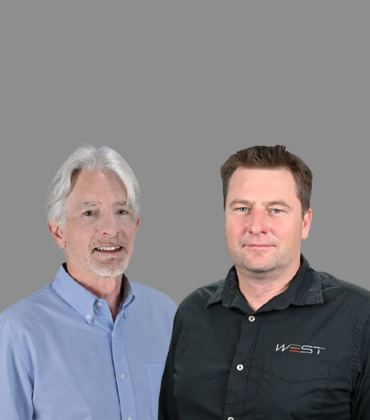
 Helené Bronkhorst, Marketing Manager and Billy de Jong, Chief Technology Officer | Co-Founder
A Young Company with a Very Old Idea
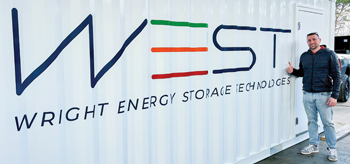
WEST was founded in 2022 by Chip Seibert and Billy De Jong to commercialize a technology whose roots run back to 1879. From a U.S. base, proven in the toughest corners of Africa and now selling into forty countries, the company is going after a slice of what its CEO calls the biggest commercial opportunity in history.
“Energy storage is becoming the glue that makes the global electrical network work more safely and efficiently. It is possibly the biggest commercial opportunity in history — a $30-trillion market over the next two decades. We're proud of what we've built so far, and we're just getting started,” says Chip Seibert, CEO, Wright Energy Storage Technologies.
Cold. Hot. Reliable. Safe.
Cold: Forty below, and falling. When White Desert built its luxury camps in Antarctica, energy storage was one of the many challenging problems on the table: no grid to lean on, most equipment hauled 4,600 km across the ice, and no tolerance whatsoever for failure.
The camp only operates in the Antarctic summer. Every winter, the entire WEST energy storage system is left idle through months of darkness, when temperatures plunge toward −60°C, then asked to perform again the moment the next season begins. It has done exactly that for three winters straight.
The solution to White Desert's problem had been elusive: the company simply could not find a storage technology that would survive those conditions. It turned out WEST had the answer just 50 kilometers from White Desert's office in Cape Town, South Africa. The fact that the technology was significantly safer than lithium-ion sealed the deal. That every component in the module could be serviced right there on the ice, rather than crated up and flown home, was a welcome bonus. White Desert has since ordered twenty more modules.
Hot: Since 2018, at the opposite end of the earth's thermometer, more than 80 WEST systems have been bolted to steel poles in Sabi Sands, part of South Africa's Mpumalanga province. They sit inside metal boxes in full sun, without air-conditioning and with nobody coming to check on them.
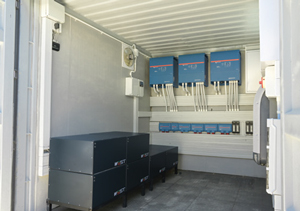 The systems keep the cameras that protect rhinos from poachers running. Lithium-ion batteries would need cooling they would never get there. If one failed in the dry heat, it would likely ignite a dangerous bushfire. The WEST systems can't be bothered; they just run. If a component were to fail, a technician could put it right with a small bag of tools and replacement parts.
Reliable: Some proof only time can provide. In 2016, WEST installed a system at Matoya Lodge, a remote tigerfish lodge in Zambia. The system is still running today, ten years on, doing its job in a place where a service call is a mission, not an errand. No chemical batteries installed alongside the supercapacitors that year are still alive.
Safe: When London's Heathrow Airport experienced a catastrophic, day-long power outage on March 20, 2025, Elliot Summey, CEO of Charleston International Airport, was paying attention. He remembered the devastation caused by Hurricane Hugo in 1989.
Summey became CEO of the Charleston Aviation Authority in 2020 and was responsible for keeping the lights on at the first and last building tourists and residents see when traveling by air. Since then, he has transformed the airport into a showpiece, but his plans remain expansive.
Following the Heathrow outage, he quietly began making plans to protect the airport from frequent power outages caused by severe local storms and regional utility supplier issues. Recently, he teamed up with Dominion Energy and a local energy systems integrator to test WEST's storage technology.
Lithium-ion was not considered safe enough for a public place where jet fuel and people are in close proximity. WEST's storage technology, with its safer design and a record to prove it, was chosen for the proof-of-concept system.
As one of the first long-duration electrostatic storage pilots on U.S. soil, the project offers both WEST and the airport an opportunity to develop a larger solar-plus-storage installation that could make the airport almost completely energy self-sufficient.
Cold. Hot. Reliable. Safe. Four sites that share almost nothing in common except that they all selected WEST energy storage.
Skate to Where the Puck Is Going, Not Where It Has Been
“Skate to where the puck is going, not where it has been.” — Wayne Gretzky.
Eleven years ago, the goal was narrow and unglamorous: build something safer and longer-lasting than lithium. Not “solid state,” not more energy-dense, just something you could trust to sit in a difficult place for decades and never let you down. The result was an energy storage system that stored electricity as electricity, with no chemical reaction to create heat that could lead to an uncontrollable fire.
-
Energy storage is becoming the glue that makes the global electrical network work more safely and efficiently. It is possibly the biggest commercial opportunity in history — a $30-trillion market over the next two decades. We're proud of what we've built so far, and we're just getting started.
Then the whole world changed. AI data centers arrived, demanding power in violent bursts that no chemical battery can smooth. Extreme weather has driven the need for more cooling, industrial production continues to rise, and the transition to electric vehicles continues in earnest.
As WEST had known all along, lithium-ion, the deeply entrenched battery storage technology, simply cannot handle the fast-switching loads created by this growth. WEST had spent a decade building for safety and longevity. The world is asking for help just as the company pushes to scale up its operations.
So What Is It, Really?
Strip away the physics, and the WEST technology is refreshingly simple to explain.
A lithium battery stores energy by driving a chemical reaction back and forth inside every cell. Charge it, and you force the reaction one way; discharge it, and you let it swing back. It works, but a chemical reaction involves the formation and breaking of chemical bonds. Overheat, damage, or push a battery too hard, and the heat it produces can increase uncontrollably.
WEST energy storage does not operate through chemical reactions. It holds energy the way a balloon, when rubbed, holds a charge: electrostatically. So there is simply no chemical reaction to produce heat. It isn't just a safer chemistry; it is the absence of the chemistry that makes WEST energy storage safe.
Why Buy Two Devices When One Device Will Do
There has always been a catch with supercapacitors. The classic ones — ultracapacitors — charge and discharge in a heartbeat, which makes them brilliant for a quick jolt and useless for anything longer. Rub a balloon, and the charge is gone by morning.
 That is why, for the better part of a century, supercapacitors were bit-part players in the energy storage industry: great for a burst, hopeless for storage.
WEST's breakthrough was to fix precisely that. Its optimized supercapacitors still deliver power the instant you ask for it, but also hold the charge. Not for seconds, but for minutes, hours, or months.
This turns a power device into a genuine storage device, and it is why a single WEST platform can do a job the rest of the industry still needs two technologies to accomplish.
Fast and Furious
A modern AI data center is a brutal place to be an electron: banks of GPUs slam the power system with thousands of sharp spikes a day, delivering microsecond bursts of energy as microprocessor workloads switch on and off.
Lithium-ion is too slow to keep up. That constant fast switching grinds a chemical battery down. The industry's workaround is to bolt an ultracapacitor onto a lithium-ion battery to “harden” it.
WEST offers tens of millions of fast-cycling events over its lifetime — the exact capability the world desperately needed and WEST already had, sitting in the same box that delivers longduration energy storage in Antarctica.
Building a Brain
The chemical battery business has been dominated by China since 1991, when Sony commercialized the first chemical batteries for use in its camcorders. China now controls 80–85 percent of the global battery industry.
 The focus, however, has been on energy density, with less emphasis on power density, safety, efficiency, or lifespan. The reason is simple: 70 percent of this supply is used in the electric vehicle industry, and 5–10 percent is used in mobile devices. Both applications require energy density to alleviate driver range anxiety and reduce the risk of device failure.
WEST flipped this equation on its head. It focused on the stationary storage industry, working to deliver adequate energy density, since stationary applications are less concerned about weight and form factor, while prioritizing safety, lifespan, power density, efficiency, and ease of maintenance.
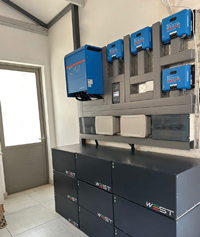
Solving the lifespan challenge, however, required WEST to build its own power management system. Chemical batteries usually last less than five years, and off-the-shelf systems were designed around shorter lifespans. WEST energy storage lasts decades, which forced the team to develop its own power management system from the ground up to match the expected lifespan of the storage technology.
From the beginning, the team focused on designing with U.S. processors and high-quality components. As demand for WEST products accelerates, more customers, particularly in the military and data center segments, are requiring a U.S. supply chain.
Lead, Follow or Get Out of the Way
A hall full of GPUs doesn't sip power; it gulps it in violent, millisecond swings as workloads spin up and collapse thousands of times a day. Those transient events ripple back through the UPS and switchgear, all the way out to the grid, punishing everything in their path.
Lithium-ion is too slow to catch the fast edges and wears down under the constant hammering. Ordinary ultracapacitors simply run out of energy after a few seconds.
WEST sits in the gap and holds the line, absorbing the relentless barrage of micro-events and staying cool while smoothing the power until, if the power fails, the generators take over. WEST storage delivers tens of millions of fast-cycling events across its working life — a number no chemical battery can come near.
Those same fast-switching loads, from big motors and EV charging to mining operations and, more recently, data centers, are landing on grids and generator sets never built to handle them.
Installing a WEST storage buffer in between smooths the swings before they ever reach the machine. Voltage holds, generators run at their steady, maximum-efficiency point instead of being oversized for peaks they will rarely see. Fuel consumption falls, and weak or renewable-heavy grids can operate much more comfortably.
The same stabilization the world is now scrambling for has been quietly proving itself in Africa and Antarctica for years.
The Part the Spec Sheet Can't Measure
Datasheets don't tell the whole story. WEST sells performance, but a good part of what people actually buy is the freedom to stop worrying about the thing under the bed.
And when the storage has done its job, it can be safely recycled at the end of a very long life. That long life is, quietly, the most sustainable thing about it — the greenest battery is the one you don't have to replace.
“Three years later, they've proven to be exactly the right call. They've handled repeated cold-soak winters without the performance loss we'd have expected from batteries — and the reduced fire risk gives us real peace of mind at a remote site where emergency response simply isn't an option,” says Luke Brauteseth, Antarctic Operations Manager, White Desert.
