




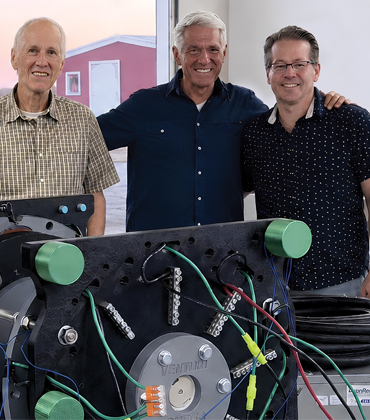
 Rick Wood, CEO, BS in Finance; Paul C. Jones, PhD; Robert A. Palmer, Magnetics Scientist; Guy Monpetit, PhD
Consider a modern data center or an industrial facility. Their operations depend on uninterrupted power, yet keeping that power available can require layers of generators, UPS systems, and additional backup infrastructure.”
Venturi believes that architecture is ripe for a rethink. Its answer is Venturi Omega, a regenerative power system built around motor/generator operation and an ultracapacitor-based energy buffer. The platform is designed to keep the ultracapacitor charged while increasing its production when demand rises, giving Venturi a different approach to reliability, redundancy, and scalability.
Venturi began as a research and development company focused on two fundamental challenges: energy and food. The company has since moved toward applications across residential, commercial, industrial, utility, and data center environments, with energy now at the center of its commercial strategy.
Recognized as the Top Renewable Energy Development Platform 2026, Venturi is now taking its regenerative technology from years of research and development into a broader range of commercial applications.
“Our system keeps the ultracapacitor (Ultra-Cap) full of electricity, no matter what the demand or draw is. Our system has the ability to increase its production to keep up with the demand,” says Wood.
Engineering Regeneration into the Energy System
Venturi Omega’s regenerative unit is paired with an Ultra-Cap, which serves as an energy buffer. The system is designed to replenish stored energy while adjusting its output as electrical requirements change, an approach Venturi sees as an alternative to relying on multiple layers of backup infrastructure.
The company has developed and holds exclusive patents and all intellectual property rights in and to a proprietary clean energy generation technology that achieves a transformative power output ratio: the system generates a substantially large quantity of electricity from a comparatively minimal energy input. The technology operates by supplying generated electrical power to a super ultra-capacitor, which in turn stores and delivers that power to end-use applications including, without limitation, residential and commercial housing, electric vehicles, power-grid applications and large-scale data centers. The technology’s efficiency characteristics, namely high output from low input, represent a material commercial and technological breakthrough that is the subject of Venturi’s patents and trade secrets.
Our system keeps the ultracapacitor (UltraCap) full of electricity, no matter what the demand or draw is. Our system has the ability to increase its production to keep up with the demand.
That operating logic underpins Venturi Omega’s modular architecture, which Venturi describes as having a ‘self-healing’ capability. Individual regenerative units operate as part of a coordinated system, so if one unit fails or requires maintenance, the remaining units are designed to continue supporting the application and compensate for the lost capacity. Wood also describes the system’s ability to respond to higher demand as part of this self-healing approach.
Longevity is another part of the platform’s design. Wood says Venturi Omega can carry a 15- to 25-year warranty depending on configuration. The UltraCap is designed to withstand 20,000 to 50,000 charge cycles, while the regenerative device has few moving parts beyond bearings that are designed to last 25 years.
The development program has also resulted in proprietary technology, patents, trade secrets, and intellectual property around Venturi’s regenerative approach. These assets support Venturi’s effort to configure the platform for different power requirements while maintaining its underlying operating principles.
Meeting the Needs of a Changing Energy Landscape
For Venturi, data centers have become one of the clearest demonstrations of where its energy technology can make a difference. Venturi is seeing strong demand from data center operators looking for ways to meet growing power requirements while maintaining reliability and redundancy.
Venturi Omega is designed for applications ranging from residential homes and communities to commercial and industrial facilities, utility-scale projects, marine systems, transportation, and large data centers. Its modular architecture allows the platform to be configured for different power requirements, from smaller residential systems to larger commercial and infrastructure applications, while maintaining the same regenerative foundation.
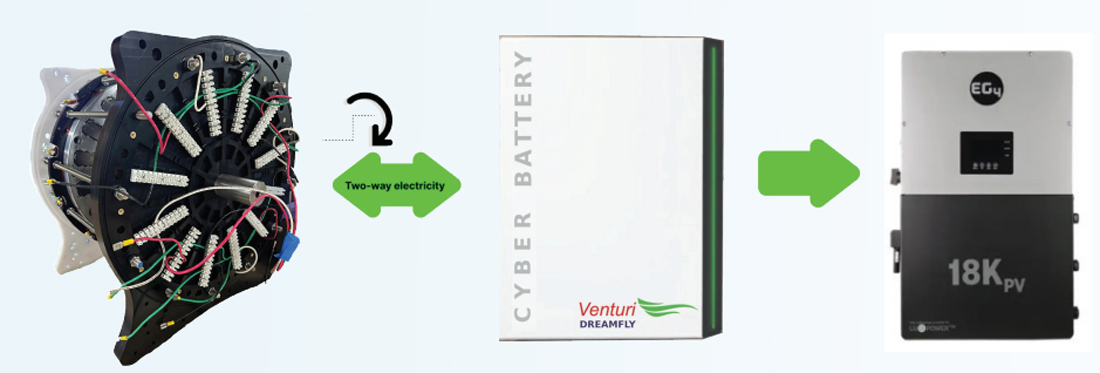 Data centers are currently generating some of the strongest demand Venturi is seeing for its technology. Their continuous power requirements make reliability fundamental to operations, while sudden changes in demand can put additional pressure on the power system. Venturi Omega is designed to respond to changes in demand while maintaining the energy buffer, an approach the company believes could reduce the layers of backup infrastructure traditionally used in high-demand environments.
“We’re being inundated with data center type applications right now. People want the technology. We can save them a lot of money because they don’t need all of the systems that they’ve had to buy in the past,” says Wood.
The opportunity extends beyond data centers. Venturi has also received interest from residential developers seeking independent power solutions for new communities, particularly where extending conventional grid infrastructure can be expensive. Commercial facilities, utilities, government projects, and other environments with critical power requirements represent additional applications for the platform.
From Research to Commercial Reality
Venturi spent roughly a decade in research and development, refining its regenerative technology and exploring how the platform could be applied across different energy requirements. That work is now moving toward commercial deployment, supported by the company’s efforts to protect the intellectual property behind the technology. The objective was to develop a technology that could serve multiple markets without requiring a separate energy architecture for each application.
That research is now moving into a broader commercial phase. According to Wood, Venturi has received letters of intent, purchase orders, sales agreements, and power purchase agreements, alongside interest from distributors, residential developers, utilities, and other potential customers exploring applications for its technology.
-
We're being inundated with data center type applications right now. People want the technology. We can save them a lot of money because they don't need all of the systems that they've had to buy in the past.
Residential applications represent an important opportunity. Venturi has developed smaller configurations intended for independent home power, while the modular nature of the technology allows capacity to increase for larger developments. For new developments in regions where grid infrastructure is limited or expensive to extend, the proposition is particularly significant: Venturi’s systems can provide independent power without requiring the same grid infrastructure traditional developments would need.
The same foundation can be configured for larger requirements. Venturi is pursuing applications across industrial operations, utility projects, data centers, marine systems, and transportation, carrying the regenerative technology into environments with very different power demands. This allows the company to build around a common platform while configuring individual systems for specific applications.
From Energy to Food
Energy may be Venturi’s immediate commercial focus, but it is only one part of the problem the company originally set out to address. Venturi began its research and development work around two areas, energy and food, with its agricultural work eventually leading to a technology for controlled-environment farming, in partnership with Vital Oxy and Dr. Guy Monpetit, an Adjunct Professor, MIT.
The company has developed a molecular-structured water technology for controlled-environment agriculture, which Wood says is intended to support plant growth and productivity. He points to a dairy operation using a conveyor-style system to grow feed for cattle as one example. According to Wood, a process that could normally take several days could produce feed overnight using Venturi’s approach, allowing it to be harvested sooner. The Venturi difference is that it can grow anything, any type of plant with remarkable yields.
Building the Next Chapter
Venturi’s progression from research to commercialization represents the next stage of a technology program built around a different approach to dependable power. The company has invested years in developing regenerative technology, protecting its intellectual property, and adapting the platform to applications ranging from individual homes to large-scale energy users.
The next phase is centered on expanding those applications. Data centers, residential developments, industrial facilities, utilities, transportation, and marine operations each present different power requirements, but Venturi Omega gives the company a common technological foundation from which to pursue them.
Venturi also intends to continue developing the agricultural and medicines technology that forms the other side of its broader mission. For now, however, energy remains the center of its commercial strategy, with Venturi Omega moving toward broader deployment across markets where dependable power is increasingly important.
That is ultimately the problem Venturi is trying to solve. Instead of adding more layers to an already complicated power infrastructure, the company is developing a system designed to generate, store, and respond to changing demand within the same architecture.
The larger opportunity for Venturi is not a single application, but a common architecture that can be adapted across them. From homes and commercial facilities to data centers and larger infrastructure, the company is now taking Venturi Omega from years of development into the next stage of its commercial journey.
