
Be first to read the latest tech news, Industry Leader's Insights, and CIO interviews of medium and large enterprises exclusively from Energy Tech Review
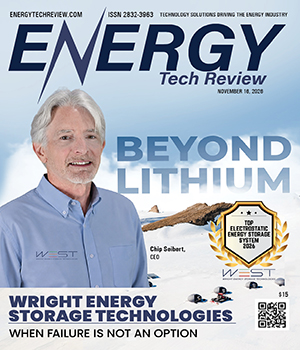
Wright Energy Storage Technologies
When Failure is not an Option
Wright Energy Storage Technologies built an electrostatic, supercapacitor-based energy storage system that survives the High Polar Plateau in Antarctica, the African bush, and the AI data center floor. The world is starting to take notice. A Young Company with a Very Old Idea WEST was founded in 2022 by Chip Seibert and Billy De Jong to commercialize a technology whose roots run back to 1879. From a U.S. base, proven in the toughest corners of Africa and now selling into forty countries, the company is going after a slice of what its CEO calls the biggest commercial opportunity in history. “Energy storage is becoming the glue that makes the global electrical network work more safely and efficiently. It is possibly the biggest commercial opportunity in history — a $30-trillion market over the next two decades. We're proud of what we've built so far, and we're just getting started,” says Chip Seibert, CEO, Wright Energy Storage Technologies. Wright Energy Storage Technologies built an electrostatic, supercapacitor-based energy storage system that survives the High Polar Plateau in Antarctica, the African bush, and the AI data center floor. The world is starting to take notice. A Young Company with a Very Old Idea WEST was founded in 2022 by Chip Seibert and Billy De Jong to commercialize a technology whose roots run back to 1879. From a U.S. base, proven in the toughest corners of Africa and now selling into forty countries, the company is going after a slice of what its CEO calls the biggest commercial opportunity in history. “Energy storage is becoming the glue that makes the global electrical network work more safely and efficiently. It is possibly the biggest commercial opportunity in history — a $30-trillion market over the next two decades. We're proud of what we've built so far, and we're just getting started,” says Chip Seibert, CEO, Wright Energy Storage Technologies.
Battery Tech
Energy security depends on domestic control of the materials powering lithium-ion batteries, not just local battery assembly. Yet cathode active materials (CAM), which determine stored energy and dominate battery performance and cost, remain heavily concentrated in China and South Korea. As demand for high-energy, high-power lithium-ion batteries grows across drones, robotics and data centers, this dependence leaves a critical gap in the U.S. battery supply chain. eJoule is developing a new path to close this supply chain gap. It produces CAM through a precursor-free production process, bypassing the conventional precursor supply chain and enabling a localized route to lithium-ion battery materials. Combined with its single-crystal nickel-cobalt-manganese (NCM) synthesis, the approach cuts waste from precursor production and improves cathode durability. “Our goal is to advance cathode manufacturing through true innovation while avoiding the solid waste, wastewater and environmental compliance challenges associated with conventional processes,” says Dr. Liang Chen, CEO.
Top Enterprise Energy Solution 2026

Power Solar began as a solution architect, coordinating external partners to bring energy projects to market. Over time, the company used vertical integration to strengthen competitiveness, gain greater control over project execution and shorten time to value, all with the aim of delivering more value to customers. It now coordinates generation, storage, resilience, demand management and carbon reporting through a single team. Projects that once took 18 to 24 months to deliver initial value now begin generating returns in under six months. “Our goal is to give customers the most value while delivering the lowest total cost of ownership for the project,” says Dustin Markowski, CEO. Underlying that approach is Power Solar’s focus on bringing energy generation closer to the facilities that consume it. For businesses facing limited grid capacity or rising energy-delivery costs, on-site generation can provide another way to address operating requirements.
Electric Vehicle

Repurposing Resources: Installing New Battery Energy Storage Utilizing Existing Infrastructure
Julian Kaufmann, Chief Commercial Officer, CAMS
Renewable Energy

Creating Space for Innovation: A Positive Cycle
Emily Greeno, Director, Energy Resource and Meteorology, Avangrid Renewables [NYSE: AGR]
Energy Solutions

Unlocking the Future of Batteries
Nicholas Grundish, VP of Battery Technology, EnergyX
Energy Solutions

Smart Grid Innovation and the Future of Energy Strategy
Kevin Sangudi, Director of Energy Advisory, Pilot Energy
Energy Storage

Key Trends Transforming QHSE, Enterprise Risk, and Compliance Strategies in Today's Energy Sector
Lon Bartoli, Head, QHSE, Risk Management, InCharge Energy

IN MY OPINION
Power Generation Solutions
Unlocking A Clean Energy Future
Bill Quinlan, President of Transmission and Offshore Wind Projects, Eversource Energy

LAST WORD
Thermal Management
Pairing Sustainability and Reliability with Modular Engineered Energy Solutions
Todd Aston, VP of Sustainability, Aggreko
IN FOCUS

Electrostatic Energy Storage Systems: Advancing High-Speed and Efficient Power Storage Technologies
Electrostatic energy storage systems deliver rapid power through advanced materials, intelligence, efficiency, resilience, and sustainability.

Shaping the Future of Lithium-Ion CAM Single-Crystal Synthesis Platforms
Lithium-Ion CAM single-crystal synthesis platforms enhance battery performance, support scalable manufacturing and improve production efficiency.
EDITORIAL
Building Infrastructure for Cleaner Energy Systems
The shift toward cleaner energy is reshaping what power grids must deliver amid rising renewable generation, higher electricity demand and more volatile weather. This edition of Energy Tech Review examines the technologies and strategies advancing safer, more reliable and accessible electricity infrastructure.
At the center is Wright Energy Storage Technologies, named Top Electrostatic Energy Storage System 2026. Founded to commercialize supercapacitor-based storage, the company has developed systems that deliver rapid power response while retaining energy for extended periods. Installations in Antarctica, African wildlife reserves and Charleston International Airport show how safety, longevity and serviceability perform where conventional batteries face limits, while also meeting the variable demands of AI data centers.
Power Solar, named Top Enterprise Energy Solution 2026, incorporates generation, storage, resiliency, demand management, and carbon accounting to make energy strategy a tangible value for businesses. Dustin Markowski, CEO at Power Solar, puts the focus on achieving the lowest total cost of ownership possible, with projects already providing profitability within six months. Their experience in cold storage, data centers, and manufacturing plants links energy costs with financial performance indicators and has implemented over 300 megawatts in 200 locations. eJoule, recognized with the Top Lithium-ion CAM Single Crystal Synthesis Platform 2026 award, improves the domestic battery supply chain by offering cathode manufacturing without any precursors and utilizing single-crystal NCM materials. According to the company’s CEO, Dr. Liang Chen, such technology not only promotes manufacturing innovation but also prevents waste issues.
The edition’s leadership perspectives talk about the infrastructure required to bring clean energy to customers. Todd Aston, VP of Sustainability at Aggreko, examines how modular power solutions, battery storage and efficient generation can help businesses pursue decarbonization without compromising reliability. Bill Quinlan, President of Transmission and Offshore Wind Projects at Eversource, highlights the role of modern transmission networks in connecting renewable resources to the grid.
These contributions show that the energy transition depends on practical solutions in which technology, infrastructure and planning advance together. Explore the edition further to examine the innovations and infrastructure shaping a safer, more reliable and cleaner energy future.
